
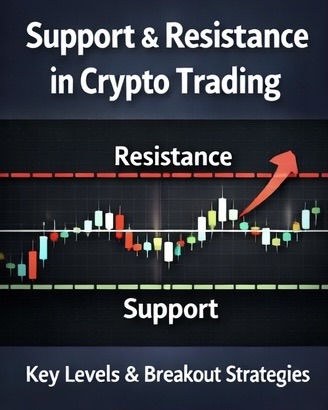
Support and Resistance in Crypto Trading (The Complete Practical Guide)

Support and Resistance in Crypto Trading (The Complete Practical Guide)
If there is one concept that separates random traders from structured traders, it is the understanding of support and resistance.
Support and resistance levels act as invisible barriers in the market. Price reacts to them repeatedly, and when used correctly, they provide some of the highest probability trading setups in crypto.
This article is part of our larger crypto education framework. If you’re new to trading, start with our foundation guide:
What Is Support?
Support is a price level where buying pressure is strong enough to prevent price from falling further.
When price reaches support:
- Buyers step in
- Selling pressure slows
- Price often bounces upward
Think of support as a “floor” where price finds demand.
What Is Resistance?
Resistance is a price level where selling pressure is strong enough to stop price from rising further.
- Sellers dominate
- Buying momentum slows
- Price often pulls back
Resistance acts like a “ceiling” in the market.
Why Support and Resistance Work
After nearly a decade of trading experience, one reality becomes clear:
Markets move based on human psychology.
Support and resistance levels form because:
- Traders remember previous price reactions
- Large institutions place orders around key levels
- Stop-losses cluster near obvious zones
- Fear and greed repeat patterns
The market is not random — it is reactive.
How to Draw Support and Resistance Correctly
Step 1: Identify Clear Reaction Points
Look for areas where price has bounced multiple times.
Step 2: Focus on Zones, Not Exact Lines
Support and resistance are areas, not precise numbers.
Step 3: Use Higher Timeframes
4-hour and daily charts provide stronger levels than 5-minute charts.
Step 4: Avoid Overcrowding Your Chart
Mark only the most obvious and respected levels.
Types of Support and Resistance
1. Horizontal Levels
Traditional support and resistance formed by repeated price reactions.
2. Trendline Support and Resistance
Diagonal levels formed during trending markets.
3. Moving Average Support
Popular moving averages like the 50-day and 200-day often act as dynamic support or resistance.
4. Psychological Levels
Round numbers like $10,000 or $50,000 often attract strong reactions.
Support Turning Into Resistance (And Vice Versa)
One of the most powerful concepts in trading:
- Broken resistance often becomes new support
- Broken support often becomes new resistance
This happens because traders who missed the breakout wait for price to retest the level.
How to Trade Support and Resistance
Strategy 1: Bounce Trading
Buy near support and sell near resistance — only in ranging markets.
Strategy 2: Breakout Trading
Wait for strong candle close above resistance or below support before entering.
Strategy 3: Retest Entry
After breakout, wait for price to retest the level before entering.
Retests often provide lower-risk entries.
Combining Support and Resistance with Candlesticks
Support and resistance become far more powerful when combined with candlestick confirmation.
Example:
- Hammer at support → bullish signal
- Bearish engulfing at resistance → potential short signal
For a deeper breakdown of candlestick patterns, read:
Risk Management When Trading Levels
Never trade support and resistance blindly.
Always:
- Place stop-loss below support when buying
- Place stop-loss above resistance when shorting
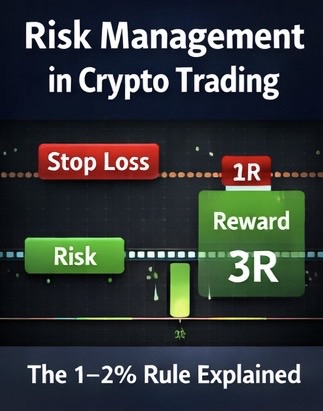
- Risk only 1–2% per trade
- Wait for confirmation
Even the strongest levels fail during high volatility.
Common Beginner Mistakes
- Drawing too many levels
- Trading every touch of a level
- Ignoring trend direction
- Entering without confirmation
- Overleveraging
Simplicity creates consistency.
Advanced Insight: Liquidity and Stop Hunts
Large players know retail traders place stop-losses just below support and above resistance.
Sometimes price briefly breaks a level, triggers stops, then reverses sharply.
This is called a liquidity grab or stop hunt.
That’s why waiting for strong confirmation candles is critical.
Structured Learning Recommendation
If you want a structured step-by-step system covering:
- Support and resistance mastery
- Chart structure
- Risk management
- Trading psychology
Final Thoughts
Support and resistance are foundational tools in crypto trading.
When combined with trend analysis, candlestick confirmation, and strict risk management, they provide structured, repeatable trading setups.
Do not rush. Study charts daily. Mark key levels. Observe how price reacts.
Mastery comes from disciplined repetition.