

Risk Management in Crypto Trading (The 1–2% Rule Explained)
Most beginner traders focus on entries. Professionals focus on risk.
The difference between long-term success and account destruction in crypto trading is not strategy — it is risk management.
This guide will explain how to protect your capital, control losses, and apply the 1–2% rule that experienced traders rely on.
If you’re new to crypto trading, start with our foundation guide first:
Why Risk Management Is More Important Than Strategy
You can have a strategy that wins 60% of the time and still lose your entire account without proper risk control.
After nearly a decade of trading experience, one lesson stands above all:
Protecting capital comes first. Profits come second.
If your capital survives, you can trade tomorrow. If it doesn’t, the game is over.
What Is the 1–2% Rule?
The 1–2% rule means you never risk more than 1–2% of your total trading capital on a single trade.
Example:
- Total account balance: $1,000
- 1% risk = $10
- 2% risk = $20
This means your stop-loss should be set so that if the trade fails, you only lose $10–$20 — not $100 or $300.
This simple rule prevents emotional destruction during losing streaks.
Why Most Beginners Blow Their Accounts
- Overleveraging
- No stop-loss
- Revenge trading
- Risking 10–50% per trade
- Trying to recover losses quickly
Crypto is volatile. Even strong setups fail. Without strict risk limits, a few bad trades can wipe out months of effort.
How to Calculate Position Size Properly
Step 1: Determine Account Size
Know your exact capital amount.
Step 2: Decide Risk Percentage
Choose 1% or 2%.
Step 3: Measure Stop-Loss Distance
Identify how far price must move to invalidate your setup.
Step 4: Adjust Position Size
Your trade size should match your risk tolerance — not your emotions.
Position size should be based on risk, not on how confident you feel.
Risk-to-Reward Ratio Explained
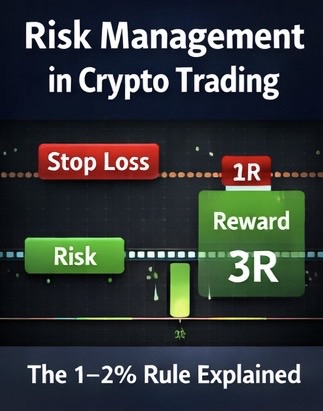
Risk-to-reward compares potential loss to potential gain.
Example:
- Risk: $20
- Target: $60
- Risk-to-reward = 1:3
This means one winning trade can cover multiple losses.
Professional traders aim for at least 1:2 or 1:3 setups.
Stop-Loss Placement Principles
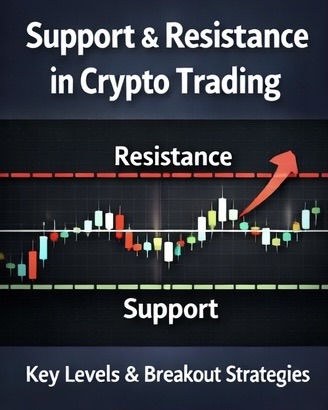
A stop-loss should be placed where your trade idea becomes invalid — not where it “feels safe.”
Good stop-loss placement:
- Below support when buying
- Above resistance when shorting
- Beyond structure, not random numbers
For a deeper explanation of support and resistance levels, read:
The Danger of Overleveraging
Leverage multiplies both gains and losses.
High leverage:
- Increases liquidation risk
- Amplifies emotional pressure
- Destroys accounts quickly
Beginners should avoid high leverage until they master risk management on spot trading.
Managing Losing Streaks
Every trader experiences losing streaks.
During a losing streak:
- Reduce position size
- Take a short break
- Review your trades
- Do not increase risk to recover losses
Discipline during losses defines professional traders.
Psychology and Risk Control
Risk management is emotional control in mathematical form.
When you risk only 1–2%, you:
- Sleep better
- Think clearly
- Trade objectively
- Avoid panic decisions
Confidence comes from controlled exposure, not oversized bets.
Structured Learning Recommendation
If you want a full structured breakdown of:
- Position sizing
- Risk-to-reward systems
- Stop-loss strategy
- Trading psychology
Final Thoughts
In crypto trading, survival is success.
Apply the 1–2% rule consistently. Focus on risk-to-reward. Protect capital first.
Over time, disciplined risk management compounds into long-term growth.
Trading is not about winning every trade — it is about staying in the game.